

Kisawa Sanctuary, Mozambique

This is my idea of complete escapism: somewhere incredibly beautiful, completely removed from everyday life, and created with a real sensitivity to the landscape around it.
Kisawa Sanctuary sits on Benguerra Island, off the coast of Mozambique, surrounded by white sand, warm Indian Ocean water and acres of dunes, forest and grassland. There are only eight residences spread across 300 hectares, so even though the property itself is enormous, it feels incredibly private.

The residences sit low in the landscape, tucked into the dunes and vegetation. Inside, the palette is warm, I love the deep green, the woven ceilings and the way the rooms open straight onto the sand. There is colour, but it feels earthy and calm. Much of the furniture and detailing was made specifically for Kisawa by craftspeople from Benguerra and neighbouring islands, using local weaving, carpentry, thatching and textile traditions.
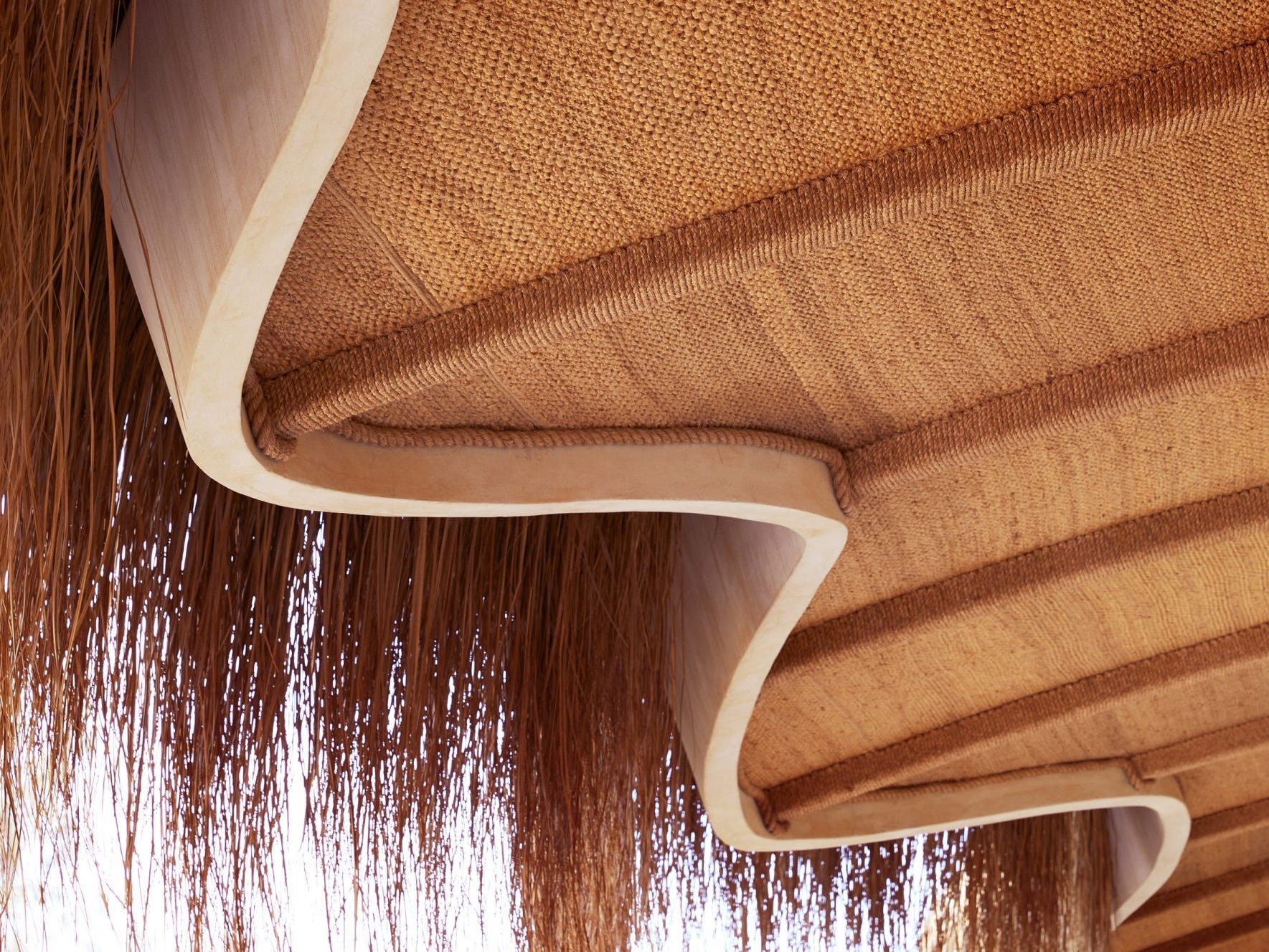
The rooms open out onto terraces and private pools, and beyond that there is simply sand and sea. You can wake up, open the doors and walk barefoot straight down to the water without passing through a lobby or seeing another guest. The water around Benguerra moves between turquoise and deep blue, with long empty stretches of white sand and the Bazaruto Archipelago stretching out around you.
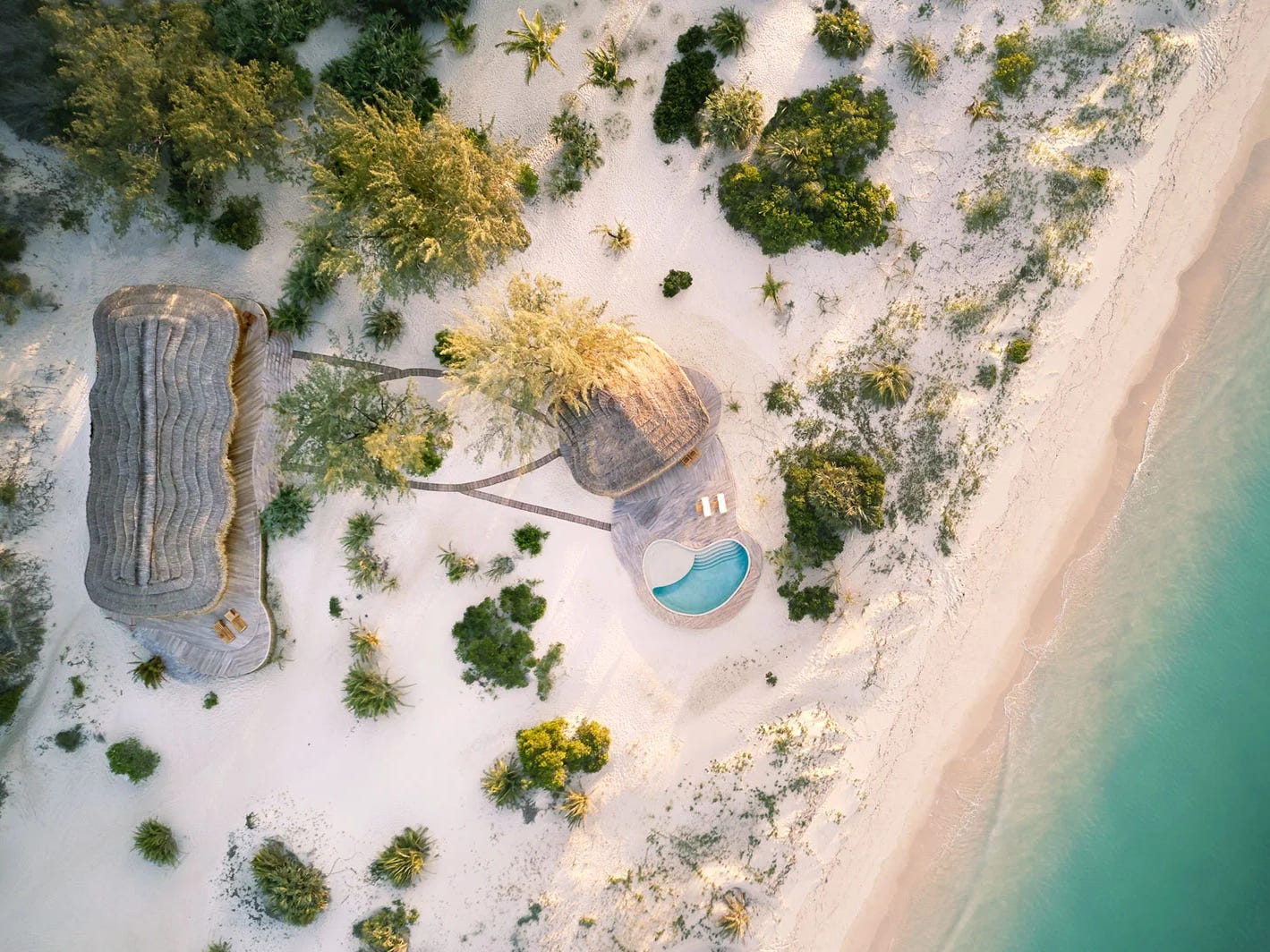
Kisawa was founded by Nina Flohr, who spent years getting to know Benguerra before building anything, at one stage living on the island simply in a tent. The residences were then positioned around the existing dunes and vegetation rather than clearing and levelling the land. They sit far apart from one another, connected by sandy paths, with curved plaster walls, thatched roofs and woven details made using local craft traditions.
The food follows the same philosophy. Produce comes from Kisawa’s own permaculture garden as well as farmers and fishermen from the surrounding Inhambane region, with seafood, vegetables, herbs and fruit shaping the menus. There is a garden restaurant where lunch can revolve around what has been picked that morning.

Another thing I really like about Kisawa is the conservation work behind it. The sanctuary is linked to the Bazaruto Center for Scientific Studies, a marine research organisation based in the archipelago. Their work includes monitoring coral reefs, marine mammals, turtles, rays and other wildlife across this part of the Indian Ocean. Benguerra sits within the Bazaruto Archipelago National Park, one of the most important marine environments in the region and home to one of the world’s remaining dugong populations.
It is obviously an incredibly luxurious place, but it is the combination of the design, the materials they’ve used to build the place, the quietness of the beach, the colour of the water, the food and the way everything seems to sit so naturally within the island, that I really love.
I can imagine waking early, walking straight out onto the sand, swimming before breakfast and I would happily spend the entire day barefoot here. That is the appeal for me.
Skall Studio and Danish Wool

I am quite particular about what I buy now. I want natural fibres, beautiful fabrics, clothes that have been made properly and pieces that will still feel good years from now. I often find European brands do this particularly well, and Skall Studio is a good example.
The Copenhagen brand was founded in 2014 by sisters Julie and Marie Skall, who grew up in northern Denmark close to the sea. Their collections are soft, feminine and understated, with lots of linen, cotton, wool and relaxed tailoring, but what I found especially interesting is the work they are doing with Danish wool.
When the sisters began looking more closely at where their wool came from, they struggled to find a supply chain that felt transparent enough. Wool might come from New Zealand, be spun somewhere else and then made into a garment in another country entirely. They wanted to bring the process much closer to home.
That led them to Hjelholt Uldspinderi, a family-run spinning mill on the Danish island of Funen that has been operating since 1878 and is now in its fourth generation. The mill has its own organic sheep farm, with a flock of around 800 sheep, and much of the wool is spun locally before being knitted in Denmark.

I love that there is nothing particularly glossy about this story. Danish wool is heavier and coarser than the very soft Merino we are used to, and the old Danish knitting machines cannot make absolutely everything a designer might dream up. Skall Studio has simply worked with those limitations rather than trying to disguise them.
The result is beautiful, chunky knitwear with traditional patterns, thick texture and the sort of weight that makes a jumper feel properly substantial. Julie and Marie have spoken about the fishermen they grew up around in northern Denmark and the old Scandinavian paintings of men wearing heavy Aran style sweaters by the sea. You can see that influence in some of their knitwear now.
There is another lovely detail too. Some of their sweaters can take up to two days to knit on a machine, so production has to begin as much as fourteen months before the collection arrives in stores. It is the complete opposite of fast fashion.

Skall Studio now even sells knitting patterns for some of its Danish wool pieces, occasionally using surplus yarn from the mill. That feels particularly relevant at the moment, with so many people returning to knitting, sewing and making things themselves.
I also like seeing brands like this turn up on people with enormous influence. Kendall Jenner has worn Skall Studio, and while celebrity dressing is obviously never the reason to buy something, I do like it when someone with access to almost anything chooses a smaller label making clothes from natural fibres and with a much slower approach to production.
What I love about Skall is that the clothes are simply beautifully made. But knowing where the wool comes from, who spins it, how slowly some of the pieces are made and how much of that Danish tradition sits behind them makes me like the brand even more.
Coffin Bay
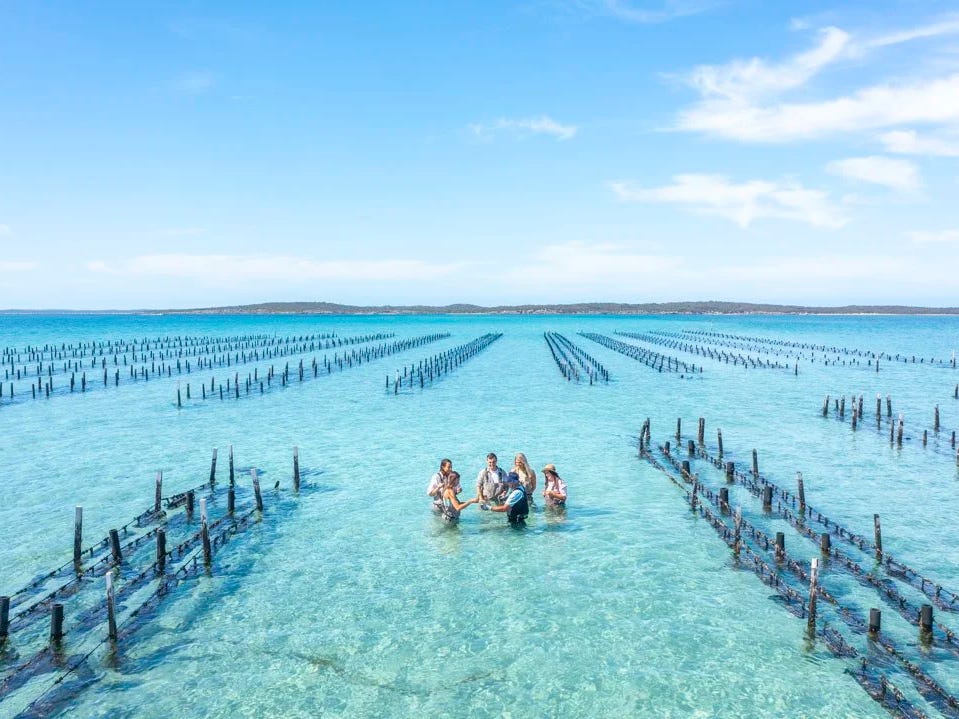
Oysters, straight from the ocean
Tucked away on South Australia’s Eyre Peninsula, Coffin bay has that extraordinary combination of wild coastline, white sand, national park and almost impossibly clear blue green water. It is also home to some of the country’s most famous oysters, grown in the cool, clean waters of the bay.
Coffin Bay Oyster Farm Tours takes you out into the shallows in waterproof waders to a pavilion sitting beside a working oyster lease. You learn how the oysters are grown, how to shuck one properly, and then eat them there with your feet in the ocean, only moments after they have come out of the bay.
The original tours were started in 2015 by oyster farmer Ben Catterall and his partner Kim, who wanted to give visitors a closer look at the industry that has shaped Coffin bay for generations. Their pavilion sits out in the bay itself, which makes the whole experience feel less like a tour and more like being briefly invited into the working life of the place.
There is local Riesling and sparkling wine too, which is exactly what I would want with them.
Long before Coffin bay became known for Pacific oysters, extensive native Angasi oyster reefs covered parts of the seafloor here. In the nineteenth century they were harvested so heavily that the reefs eventually collapsed. Today, local oyster farmers and researchers are helping restore those native reefs.
Oysters naturally filter the water around them as they feed on microscopic plankton carried through the bay by the tides.
Coffin bay is around 45 minutes from Port Lincoln, which is roughly a 40 minute flight from Adelaide. I would make more of the trip than just the oyster tour. Coffin Bay National Park is right beside it, with huge dunes, empty beaches, quiet coves and long stretches of coastline that still feel wonderfully untouched.
For me, the best part is the thought of sitting out in that startling blue water, opening an oyster yourself, a glass of something cold beside you, and eating it only metres from where it had been growing.
Something to try at home.
Oysters with finger lime
This barely needs a recipe, it’s so simple.
Arrange freshly shucked oysters over crushed ice.
Spoon a few finger lime pearls over each one and add the smallest squeeze of fresh lime. If you want a little more, add a few drops of good extra virgin olive oil and some very finely chopped chives.
The finger lime gives you those tiny bursts of citrus without covering the flavour of the oyster, and it feels particularly right with something grown on the Australian coast.

I really enjoyed putting these three together this week. I hope there was something here you loved too.
See you next Sunday,
Anna xx